.png)





Packaging design trends in India are shifting faster than most founders realise. What converts on Amazon now fails on Blinkit. And what worked in modern trade gets ignored in a D2C Instagram reel.
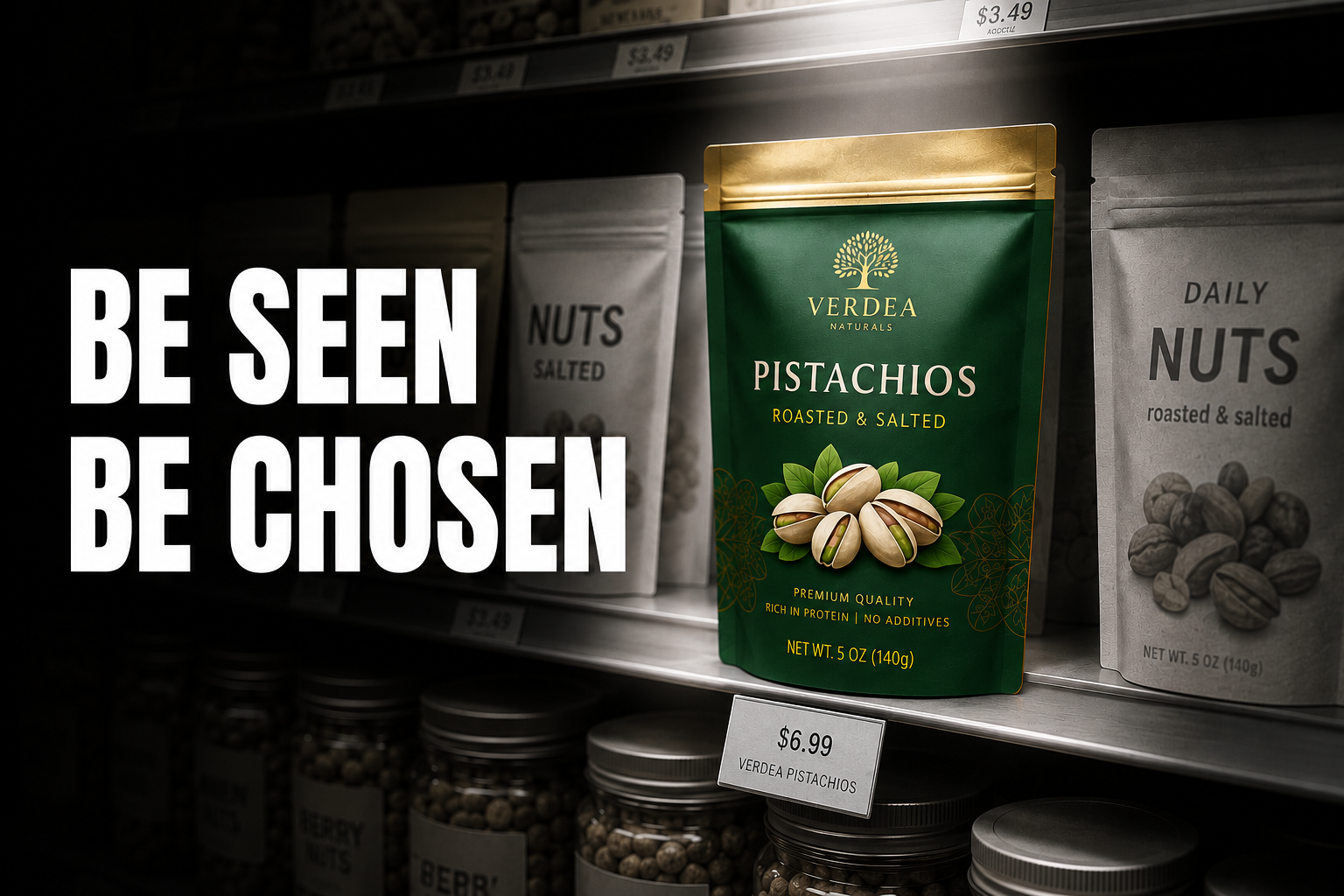
The brands winning in 2026 are designing packaging systems that work across all four surfaces: shelf, screen, quick-comm thumbnail, and unboxing. If your packaging only solves one of these, it is already leaving money on the table.
Here is what is actually driving decisions right now, across Indian D2C categories.
1. Purposeful Minimalism Has Replaced Generic Clean
A few years ago, "clean packaging" meant white backgrounds and thin fonts. Every brand in wellness, skincare, and clean food started looking identical. That era is over.
In 2026, the strongest Indian D2C packaging uses what designers call purposeful minimalism: stripping away everything that does not communicate value, and making every remaining element carry weight.
The Whole Truth is the clearest example. Their packaging lists every ingredient in plain English, no illustrations, no lifestyle shots. The whitespace is not laziness. It is the proof point. "We have nothing to hide" is communicated through layout, not words. Their competitors use illustration and warm colours to suggest health. The Whole Truth uses radical typographic transparency to prove it.
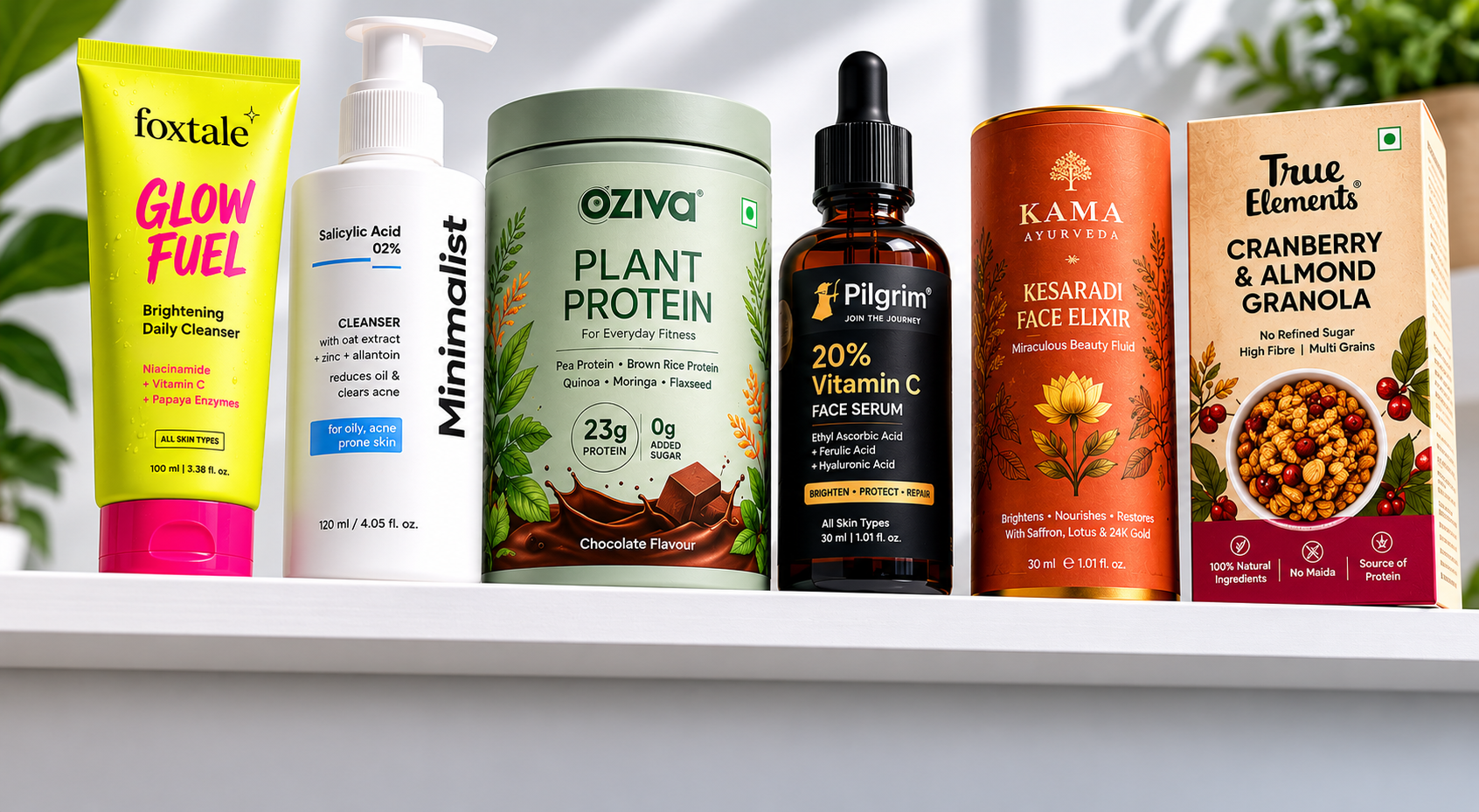
Minimalist (skincare) uses a near-identical logic in a different category. The ingredient percentage in large type is not just design; it is trust, compressed into a label. Across many skincare categories, brands with highly decorative packaging often struggle to communicate the same level of clinical credibility.
If you are rebuilding your packaging in 2026, the question is not "how do we make it look cleaner?" It is "what single truth can our packaging tell that no decorator element can fake?"
2. Quick Commerce Has Completely Changed Thumbnail Design
Blinkit, Zepto, and Swiggy Instamart are no longer secondary channels for most direct-to-consumer everyday packaged product brands. For categories like health drinks, snacks, and skincare, quick commerce now drives 20-35% of direct-to-consumer sales revenue. And the thumbnail is 80x80 pixels.
Packaging designed for shelf presence at eye level does not automatically translate to a winning thumbnail. The contrast ratios that pop under fluorescent retail lighting do not always hold on a mobile screen at 11 PM. Product name hierarchies built for 30-cm viewing distance collapse at thumbnail scale.
The brands adapting fastest are building what can be called "two-way functional packaging" (packaging designed to work on both physical shelves and digital screens); one design system that works at shelf scale and at digital thumbnail scale simultaneously.
MCaffeine's neon-dominant packaging is a strong case study here. The bold background colours (yellow, green, orange) that felt aggressive on early retail shelves now function perfectly as thumbnail identifiers. A Blinkit shopper scrolling at speed can distinguish MCaffeine from a generic protein supplement in under half a second. That brand recognition at thumbnail scale is not accidental; it is a result of a packaging system that was built with colour saturation and contrast as the primary design constraints.
The practical implication: before finalising any packaging, run a thumbnail test. Export the packaging image at 100x100 pixels. Can you read the product name? Can you identify the brand? Is there a dominant color association? If the answer to any of these is no, your packaging needs adjustment before print, not after.
.png)
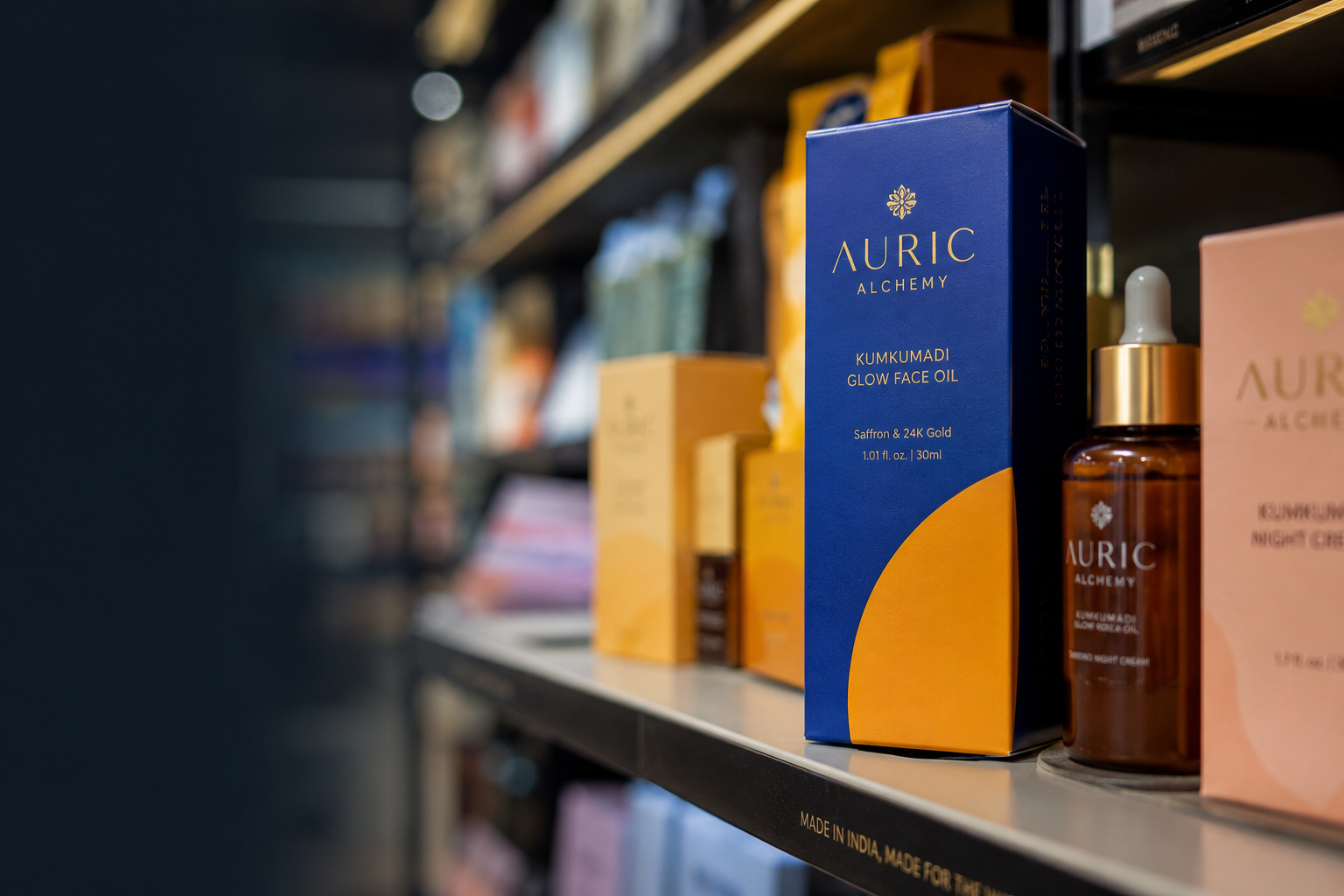
3. Tactile and Material Differentiation Is Becoming a Retail Buy Signal
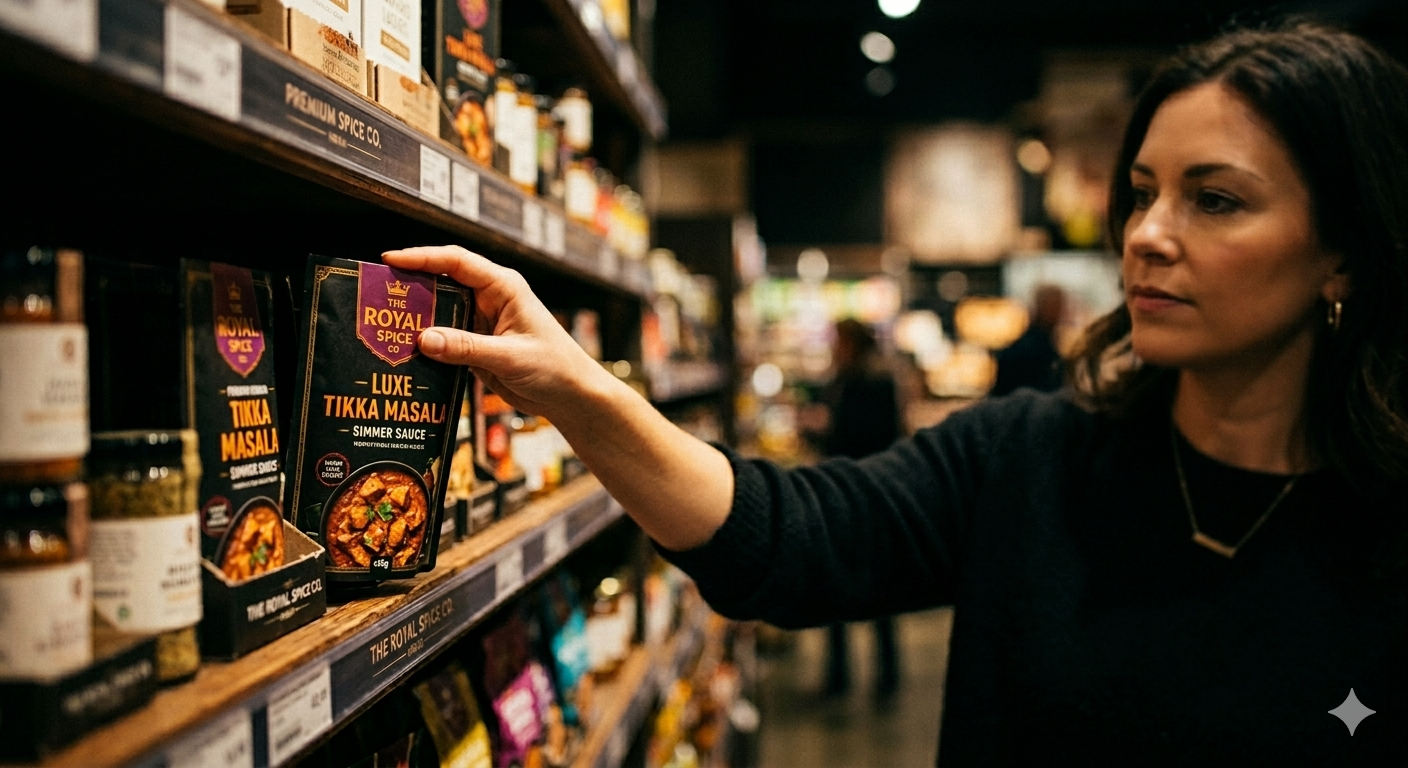
India's large supermarket chains (stores like Reliance Smart and D-Mart) retail buyers (BigBasket, Reliance Smart, D-Mart) are seeing more D2C brands pitch every month. They are experienced at filtering. Packaging that looks good in a digital presentation document but feels generic in hand does not convert to a retail shelf-space agreement.
In 2026, tactile and material differentiation is a commercial differentiator, not just an aesthetic one.
Soft-touch lamination, spot UV, embossed logos, and kraft paper exteriors are no longer premium-tier exceptional; they are expected for D2C brands pitching large supermarket chains above INR 300 printed price. What is differentiated now: textured paper types, debossed patterns, metallic foil details that serve functional legibility rather than decoration, and packaging material choices that communicate the product's values before the consumer reads a word.
Plum Goodness made a visible shift toward matte, soft-touch packaging across their skincare line in 2023-24. The shift was not just visual. The packaging material change did the job of changing market perception. The brand did not change its product recipes, its price level, or its marketing. Retailers reported it as a tactile upgrade that elevated perceived quality to a tier where Plum could hold shelf space next to Clinique imports without looking outclassed.
The question for Indian D2C founders is not "can we afford better material?" It is "what does a buyer or consumer conclude about our product in the first 2 seconds of physical contact?" If the answer is "nothing distinctive," your material selection is a branding problem.
4. India-Rooted Aesthetics Are Replacing Generic Global Minimalism
Indian D2C brands spent much of 2019-2023 chasing European or Korean aesthetic references. The result: a group of Indian brands that looked like they were designed in Berlin or Seoul, with no visual connection to the consumer they were selling to.
2025-26 is seeing a correction. Not a retreat into generic "ethnic" clichés (paisleys, temple motifs, lotus patterns), but something more sophisticated: design systems that draw on Indian colour intelligence, material culture, and visual storytelling traditions while presenting as premium and modern.
Pilgrim built its identity on Korean beauty science while keeping its packaging visuals completely adapted for Indian skin tones and Indian beauty ritual language. The result is a brand that feels internationally sophisticated without being culturally alien. The colour palettes draw from Indian skin-tone resonance, not Korean cosmetics retail norms.
Nykaa's store-brand packaging across their beauty specialized spin-off brands has moved deliberately toward earth tones, Indian-origin ingredient visual cues, and typography that feels both premium and familiar to the Indian beauty buyer. This is not nostalgia; it is a strategic recognition that Indian D2C buyers in 2026 want premium without feeling foreign.
For founders, this trend means the reference board for your packaging should include Indian artists, Indian textile traditions, Indian colour systems; not just Scandinavian or K-beauty references. The brands that own this territory in the next three years will have a visual identity that is genuinely theirs.
.png)
5. Sustainability Is Moving From Marketing Claim to Material Choice
The conversation has moved. It is no longer "should we use sustainable packaging?" It is "which sustainable packaging choice communicates our values without adding cost that the consumer will not accept?"
For Indian D2C brands, this is a real operational tension. Sugarcane paper, recycled plastics, and glass alternatives carry cost premiums that affect profit margins, especially at the INR 50L-INR 5Cr annual sales level. But for premium-positioned brands (above INR 400 printed price), packaging that uses obviously newly manufactured plastic now creates a trust gap with the consumer who has read your sustainability claims on your website.
Yoga Bar moved to recyclable packaging and communicated the shift explicitly on the pack, turning a production and distribution network decision into a brand proof point. The messaging was not "we use eco-packaging"; it was integrated into the ingredient story, making sustainability feel like part of the product's health positioning, not a separate corporate claim.
The practical framework for D2C founders in 2026: prioritise sustainable material choices for external packaging (box, wrapper, bag) where the consumer sees it most. The inner packaging (tray, liner, sachet) can optimise for product safety over sustainability without damaging perception, because most consumers do not inspect inner packaging with the same scrutiny.
6. Product Consistency Across Different Flavors and Sizes Is Now a Brand Multiplier
One of the clearest differentiators between brands that scale and brands that plateau is having layout rules for different product variants. Brands that launch with 3 product variants and then add 7 more over 18 months, each with a slightly different visual treatment, create what retail buyers call "visual clutter on the shelf"; a dedicated shelf space that looks like four different brands share the same category.
Mamaearth's evolution is instructive here. Their early product variety had inconsistencies that were visible across their vitamin C, onion oil, and moisturizer lines. By 2022-23, they rebuilt their visual system with a tighter typographic hierarchy, a defined illustration style, and a consistent colour coding logic across categories. The result: the brand holds a full dedicated shelf space in large supermarket chains, and every product variant reads as Mamaearth from 3 metres away.
For D2C founders adding variants or secondary product collections: the brand structure and organization question must be answered before the design brief starts. Are these secondary product variants in the same family (same design system, different accent colour)? Or are they a separate line (different design language, unified by logo only)? Without a clear answer, designers will default to visual improvisation; and that is how visual clutter on the shelf gets built.
What This Means If You Are Designing Packaging Right Now
The six trends above have a common thread: packaging in India in 2026 must carry more commercial weight than it ever has.
More sales platforms mean more contexts to design for. Smarter consumers mean less tolerance for visual dishonesty. Better-funded competitors mean your packaging cannot be "good enough"; it has to be category-defining.
The brands that win at shelf and online are not the ones with the biggest budgets. They are the ones who made clear design decisions early, built them into a system, and applied that system consistently across every product variant, every platform, and every retail context.
If your packaging was designed for a stage your brand has outgrown, or if it was built without a retail buyer or quick-comm sales platform in mind, now is the time to address it. Not after the next funding round. Before the next retailer meeting.
[Jellypop designs packaging systems for funded Indian D2C brands; built for shelf, screen, and quick commerce from day one. See our packaging work →]