
.png)





Choosing a branding agency is one of the highest-stakes decisions a D2C founder makes. Get it right, and your products earn a spot on the right retail shelf, your Blinkit listing gets noticed in a sea of competitors, and your next investor deck looks like it belongs to a category leader. Get it wrong, and you spend INR 3–8 lakh, lose four months, and end up rebuilding anyway: often right before a retail launch or fundraise, when you can least afford the delay.
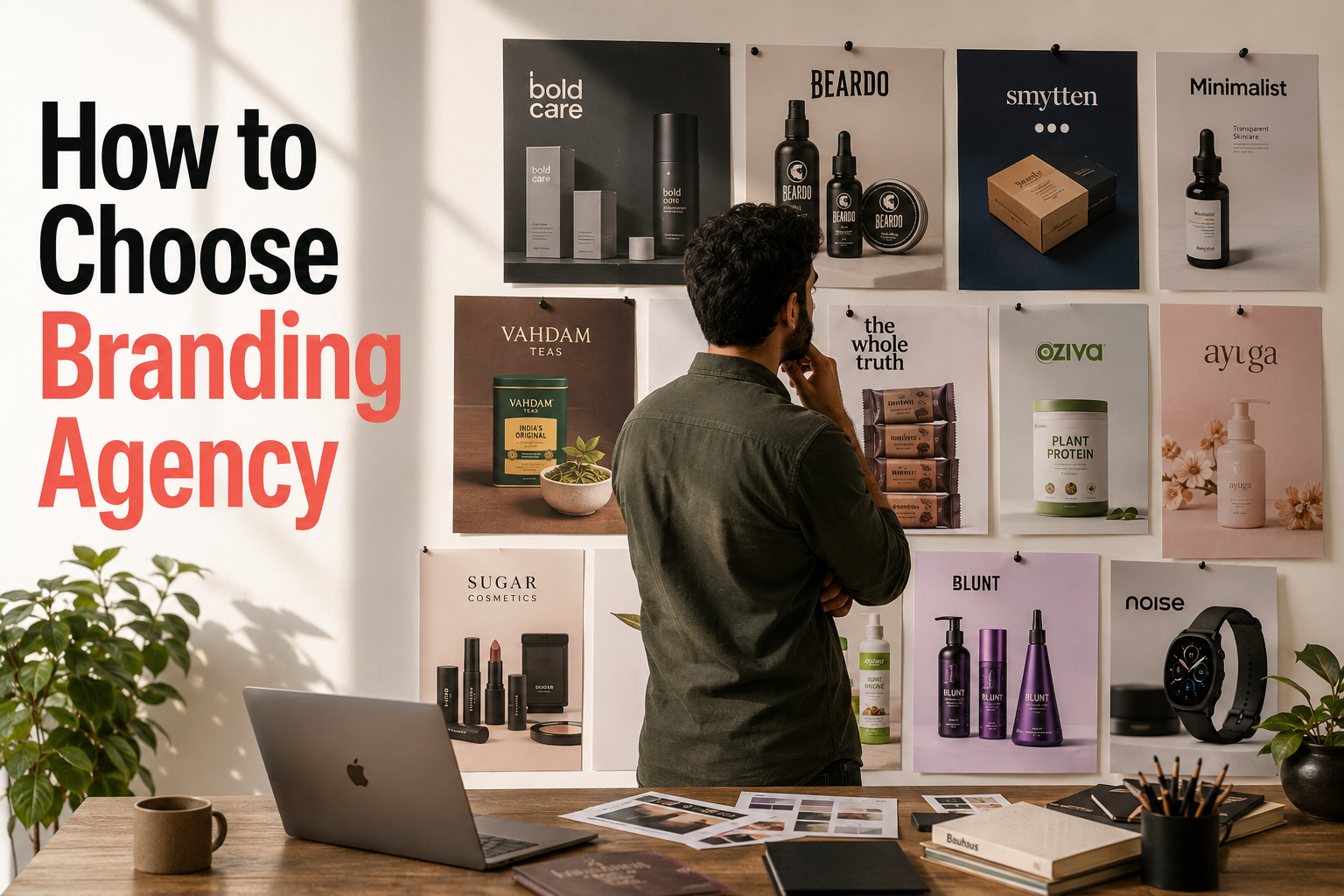
Most founders think they're buying design. What they're actually buying is category positioning, shelf differentiation, and growth readiness. A branding agency for a D2C brand isn't a design vendor producing logos and colour palettes: it's the team responsible for how your product performs on a modern trade shelf, in a Blinkit listing, on an Amazon search page, and on a scroll through Instagram. If the agency doesn't think in those terms, the branding will look fine and still fail to convert.
Here's exactly how to choose the right one.
Why Most D2C Founders Pick the Wrong Agency
The most common mistake: founders choose an agency based on aesthetics alone. They see a beautiful portfolio, feel a vibe, and sign. The problems usually show up later, and they're rarely just cosmetic:
- Poor retail visibility. Packaging that looks good in a deck doesn't stand out on a crowded shelf, and a retail buyer passes on the product.
- SKU confusion. A range where every product looks like it belongs to a different brand, making it hard for shoppers to recognise the line or trust it as one system.
- Weak price perception. Packaging that doesn't visually support the price, so a INR 600 product looks like it should cost INR 250.
- Low repeat recognition. Customers can't easily spot the brand again on a re-order, in a store, or in a quick commerce search: so recall and repeat purchase suffer.
India's D2C market is large and growing quickly, and a significant share of Indian D2C brands struggle to scale past a certain revenue point: often because their branding doesn't hold up once they move into retail, marketplaces, and quick commerce. Poor agency selection is frequently part of that story.
When this goes wrong, the cost isn't just the original agency fee. It's the repackaging cost when the design doesn't work on shelf, the retail listing redesign when a buyer rejects the packaging, the print rework when files aren't production-ready, and the lost time on a launch that gets pushed back by months while everything gets redone.
The right agency doesn't just make you look good: it makes your brand commercially competitive: easier to spot on shelf, easier to trust on screen, and easier to scale across quick commerce, marketplaces, and modern trade without redoing the work later.
6 Things to Check Before You Choose a Branding Agency
1. Portfolio Fit: Have They Worked in Your Category?
A branding agency that builds beautiful hotel identities isn't the same as one that understands FMCG shelf dynamics. Before anything else, check:
- Do they have case studies in your category (skincare, wellness, clean food, supplements)?
- Does their packaging work look ready to convert, not just ready for an award?
- Have they executed multilingual packaging, FSSAI-compliant labels, or retail-format variations?
- Have they launched new products, not just rebranded existing ones?
- Have they built systems across multiple SKUs, not just single hero products?
- Have they worked across both marketplaces and physical retail?
Red flags to watch for:
- A portfolio full of mockups, with no production photos
- No shelf photography: only studio renders
- No examples of how the packaging performed once it was actually in market
Look for an agency that can explain the reasoning behind their past work, not just show you what it looks like. A good sign is when they can point to a specific shift: say, a brand that moved from a crowded, generic look to something more distinctive: and explain why that change made sense for the category and the retail context, not just as a style update.
2. Process Clarity: Do They Have a Structure?
A credible agency runs a defined engagement, with clear stages and outputs. A typical branding process should include:
- Discovery: understanding your product, audience, and goals
- Category audit: reviewing competitors, shelf context, and where the gaps are
- Positioning: defining what the brand stands for and how it's different
- Naming (if applicable): for new brands or product lines
- Identity: logo, typography, colour system, and brand guidelines
- Packaging: primary and secondary packaging design, dieline-ready
- Production support: helping the design survive contact with a printer
Ask what happens in Week 1, Week 3, and Week 6, and what you'll receive at the end of each phase. If the answer is vague: "we do a deep dive and then present options": keep asking. A vague process tends to produce vague outcomes.
Red flag: an agency that shows you logo concepts before any strategy or positioning work has been done. That's usually a sign they're designing first and figuring out the "why" later, if at all.
For a studio that combines brand strategy and packaging design in a single structured engagement, see our brand strategy and packaging agency service page for the full process breakdown.
3. Commercial Understanding: Can They Improve How Your Product Performs?
This is one of the most important things to evaluate, because it's where most agencies fall short. Your packaging has to work in at least three environments at once: a BigBasket thumbnail at 80 pixels wide, a modern trade shelf at eye level, and an Instagram scroll between two reels. An agency that only designs for screens will hand you packaging that fails the moment it goes to print.
The real questions to ask aren't about taste: they're about outcomes:
- Can this packaging improve discoverability on a crowded shelf or listing page?
- Can it improve click-through on a marketplace or quick commerce thumbnail?
- Can it visually justify a premium price point?
- Have they worked on product ranges with 4 or more variants, and do those variants feel like one family?
- Do they deliver print-ready structural packaging templates, not just flat artwork?
- How do they approach label design when FSSAI requirements eat into the available creative space?
Indian brand example: MCaffeine's packaging is a good reference point for commercial thinking. The neon, single-ingredient hero format works at thumbnail scale, at shelf scale, and across every ad format the brand runs. Every variant tells the same visual story in the same visual language: which matters, because when a brand has 10 variants that each look like a different studio designed them, shoppers stop trusting the product before they even read the label.
Ask specifically about thumbnail performance (how the packaging holds up at small sizes on Blinkit, Zepto, or Amazon), retail shelf performance (how it holds up next to competitors at eye level), and multi-channel consistency (whether the same system works across all of these without falling apart).
See our guide to how packaging impacts ecommerce conversions for the specific performance benchmarks: thumbnail test, product page hierarchy, unboxing consistency, that separate commercially built packaging from aesthetically built packaging.
4. Founder-Fit: How Will You Actually Work Together?
Speed matters, but it's only part of the picture. What matters more is who you'll actually be working with, how decisions get made, and how well that fits your way of working as a founder.
Big agencies often take on long retainers and hand the day-to-day work to junior designers after the initial pitch. Freelancers can be fast but inconsistent, and sometimes disappear after the first payment. Neither extreme is automatically wrong: it depends on what you need and how involved you want to be.
Questions worth asking:
- Who will actually work on the project day to day?
- How often will you interact directly with senior creatives, versus account managers?
- What's the typical turnaround time on feedback and revisions?
- What does a typical project timeline look like for a brand at your stage?
As a rough guide, a branding engagement covering a logo, identity system, and packaging for 2 variants is often completed within 6–10 weeks by a focused studio. A 4–6 month timeline for that same scope may simply mean the studio is set up for larger, slower-moving clients: which isn't necessarily bad, but it's worth knowing upfront so you can plan around it.
5. D2C-Specific Experience: Do They Understand Your Channels?
A studio that understands D2C knows your brand has to work across several channels at once, each with its own requirements:
- Quick commerce (Blinkit, Zepto, Swiggy Instamart): thumbnail-scale legibility, high-contrast packaging, instant recognition
- Ecommerce marketplaces (Amazon India, Nykaa): the main image has to carry the entire product story on its own
- Modern trade retail: shelf presence, category fit, and meeting retail buyer expectations around labelling and compliance
- Your D2C website: visual storytelling and product pages designed to convert
- Social commerce: packaging and visuals that hold up when shared, screenshotted, or featured in short-form video
This also extends to practical things like packaging compliance (FSSAI labelling, mandatory declarations) and whether the brand is actually ready for a product launch: print files, dielines, and variants all sorted before the launch date, not scrambled together after.
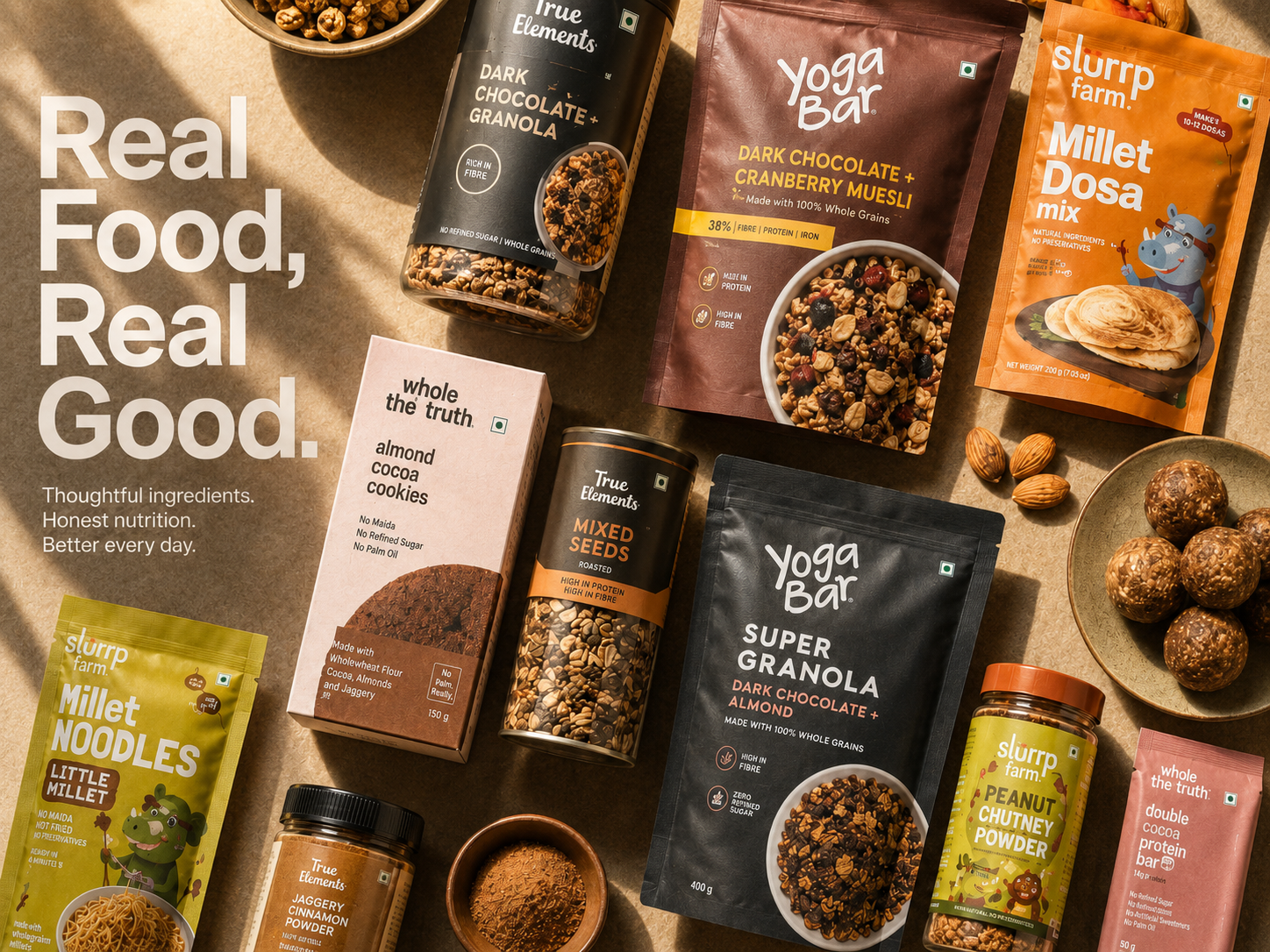
Indian brand example: The Whole Truth's packaging lists every ingredient in plain English, with no marketing language layered on top. That works commercially because it was designed for the online D2C customer first: someone reading the label with time and intent, rather than a shopper glancing at it for two seconds in a store. The agency that designed it understood the channel before they designed the label, which is exactly the kind of thinking worth looking for.
6. References and Outcomes: What Actually Changed After the Rebrand?
This is one of the most useful things you can dig into, and one of the most commonly skipped.
Awards measure creativity. Outcomes measure whether the work actually moved the business forward. Ask for founder references, not just client logos, and ask specifically what changed after the rebrand: not just whether the founder liked the new look.
Useful metrics to ask about:
- Did conversion rate improve on the product pages after the new packaging went live?
- Did click-through rate improve on marketplace or quick commerce listings?
- Did the brand get into new retail accounts, or expand within existing ones?
- Was there a measurable sales lift after launch?
- Did repeat purchase rate change?
- Did average order value (AOV) shift?
Sample questions to ask a reference founder: "What's different about your sales or retail conversations since the rebrand?" "Did anything specific happen with a retailer or marketplace listing after the new packaging launched?" "Would you make the same agency choice again, knowing what you know now?"
If the agency can only point to awards and portfolio pieces, they're optimising for their own portfolio: not necessarily for your growth.
See our guide to branding lessons from successful Indian startups for real examples of what changed commercially after a rebrand: across CTR, retail placement, and repeat purchase, for brands like Minimalist, Yoga Bar, and The Whole Truth.
Freelancer vs. Boutique Studio vs. Full Agency: Which Is Right for You?
For most Indian D2C founders at the INR 50 lakh to INR 10 crore revenue stage, a boutique studio with D2C focus tends to be the strongest fit: strategic input, full execution, reasonable speed, and direct access to the people doing the work.
One thing worth keeping in mind: the cheapest option often becomes the most expensive once you factor in rework, redesigns, and delayed launches. A lower upfront quote isn't a saving if the output doesn't survive contact with a printer, a retail buyer, or a quick commerce thumbnail.
See our guide to the top branding firms for Indian D2C brands for a ranked breakdown of which studios at this tier are most referenced by Indian founders, with an honest breakdown of what each does well and where each falls short.
How Much Does Branding Cost for an Indian D2C Brand?
Realistic ranges for 2026, and what's typically included in each:
- Logo and basic brand identity: INR 50,000–INR 2L. Usually covers a logo and very basic guidelines: enough for early-stage use, but not a full system.
- Full brand identity system: INR 1.5L–INR 5L. Logo, typography, colour system, and a proper brand guidelines document covering how the identity should be used across touchpoints.
- Packaging design (primary + secondary, 1–2 SKUs, dieline-ready): INR 1.5L–INR 4L. Includes structural packaging files ready for a printer, not just flat label artwork.
- Full brand + packaging engagement (identity + 4 SKUs + digital brand kit): INR 4L–INR 12L. A more complete engagement covering identity, a multi-SKU packaging system, and assets for digital use.
- Website design (Webflow, D2C-optimised): INR 2L–INR 8L. Depends heavily on the number of pages, custom interactions, and whether ecommerce functionality is included.
Comparing branding proposals purely on cost can be misleading. Some agencies charge significantly more because of the depth of strategy and research involved, the level of packaging production support included, or genuine category expertise that reduces the risk of costly mistakes later.
Be cautious of any studio quoting under INR 50,000 for a full brand identity. At that price point, you're typically getting templates rather than a system: and a brand that doesn't hold together across 6 SKUs and 3 channels tends to cost far more in rework and lost retail opportunities than it saved upfront.
Red Flags When Hiring a Branding Agency
A few warning signs worth taking seriously before signing anything:
- No strategy phase. If the engagement jumps straight to visual concepts without any discovery, category audit, or positioning work, the foundation is missing.
- No production knowledge. If the team can't speak confidently about dielines, print specifications, or how packaging materials behave, the design may not survive the move from screen to physical product.
- Portfolio only shows logos. A logo is a small part of a brand system. If that's the bulk of what's on display, packaging and broader brand thinking may not be a strength.
- No category experience. An agency with no relevant work in skincare, food, wellness, or similar categories will likely need to learn the category at your expense.
- Cannot explain commercial outcomes. If every answer comes back to how something looks, rather than what it achieved, that's worth noting.
- Overpromises on timelines. A studio promising a full brand and packaging system in 2–3 weeks is either underestimating the work or planning to rush it.
- No founder references. If a studio can't connect you with a past client who'll talk honestly about the experience, that's a meaningful gap.
Questions to Ask Before Signing
A short checklist worth working through with any agency you're seriously considering:
- What research do you conduct before starting design work?
- Who will actually work on my project: and can I meet them?
- What happens after handoff? Is there any support once files are delivered?
- Do you support print production, or is that handled separately?
- How do you validate packaging decisions: thumbnail tests, shelf mockups, print proofs?
- Can I speak to founders you've worked with before?
- What does the full process look like from kickoff to final files?
- What's included in the quote, and what would be considered out of scope?
A studio that answers these clearly and specifically is usually one that's done this enough times to have real answers: not just a pitch.
What Makes Jellypop Different
Jellypop is a branding and packaging studio built specifically for Indian D2C founders working in skincare, wellness, food, and personal care: categories where shelf context, retail compliance, and quick commerce visibility all matter from day one.
Jellypop is a good fit if:
- You're at the pre-seed to Series A stage and need your brand to look like a category leader, not a startup
- You need packaging that's print-ready, FSSAI-compliant, and built to work across retail, marketplaces, and quick commerce
- You want a brand identity, packaging system, and D2C website handled as one connected system, not separate disconnected projects
Jellypop may not be the right fit if:
- You're past Series B and need a large team working across multiple parallel brand initiatives
- You're only looking for a single deliverable (just a logo, for instance) with no broader packaging or positioning need
- You need an agency with deep experience outside FMCG, skincare, wellness, and personal care categories
Jellypop's approach is packaging-first: brand identity and packaging design (primary and secondary, print-ready, FSSAI-compliant) and D2C website design are handled within one engagement, with the same team involved from positioning through to production-ready files.
See our work and start a conversation at jellypop.design.
.png)