
.png)





A memorable D2C brand is one that consumers recognise, trust, and return to; without needing a discount to close the sale. Building that in India in 2026 is harder than it was three years ago. Customer acquisition cost (the money spent to get one new buyer) across Indian D2C has risen nearly 30% year on year. On-demand fast delivery services (apps like Blinkit and Zepto) have added a third product display setting alongside physical retail and online shopping websites. And consumers in urban India are now comparing your brand, consciously or not, against international standards.
The founders who build memorable brands are not the ones with the biggest budgets. They are the ones who make clear decisions early; about what their brand stands for, what it looks like, and what it says without words; and hold those decisions across every customer interaction point.
Here is how to do it, in order.
Step 1: Start With One True Thing About Your Brand
Every memorable Indian D2C brand can be reduced to one true thing. Not a tagline. Not a mission statement. A single, honest claim about what makes this brand different from everything else on the shelf.
The Whole Truth built its entire brand on radical ingredient transparency. One true thing: "We will tell you exactly what is in this bar, and nothing we tell you will be a marketing claim." Every packaging decision, every colour choice, every typographic rule flows from that single truth.
MCaffeine reduced its brand to one true thing: caffeine is the hero ingredient, and this brand belongs to people who live fast. Neon colours, bold type, single-ingredient naming conventions; all of it is a visual and verbal expression of that one truth.
Before you brief a designer, before you choose a colour palette, before you register a brand name; write one sentence that captures what only your brand can honestly say. That sentence is your brand foundation. If you cannot write it clearly, the brand will never be coherent, no matter how much you spend on design.
The test: Read your one true thing to a stranger. If they say "that could be any brand," rewrite it. If they say "that sounds like you," you have it.
Step 2: Build a Visual Identity System, Not Just a Logo
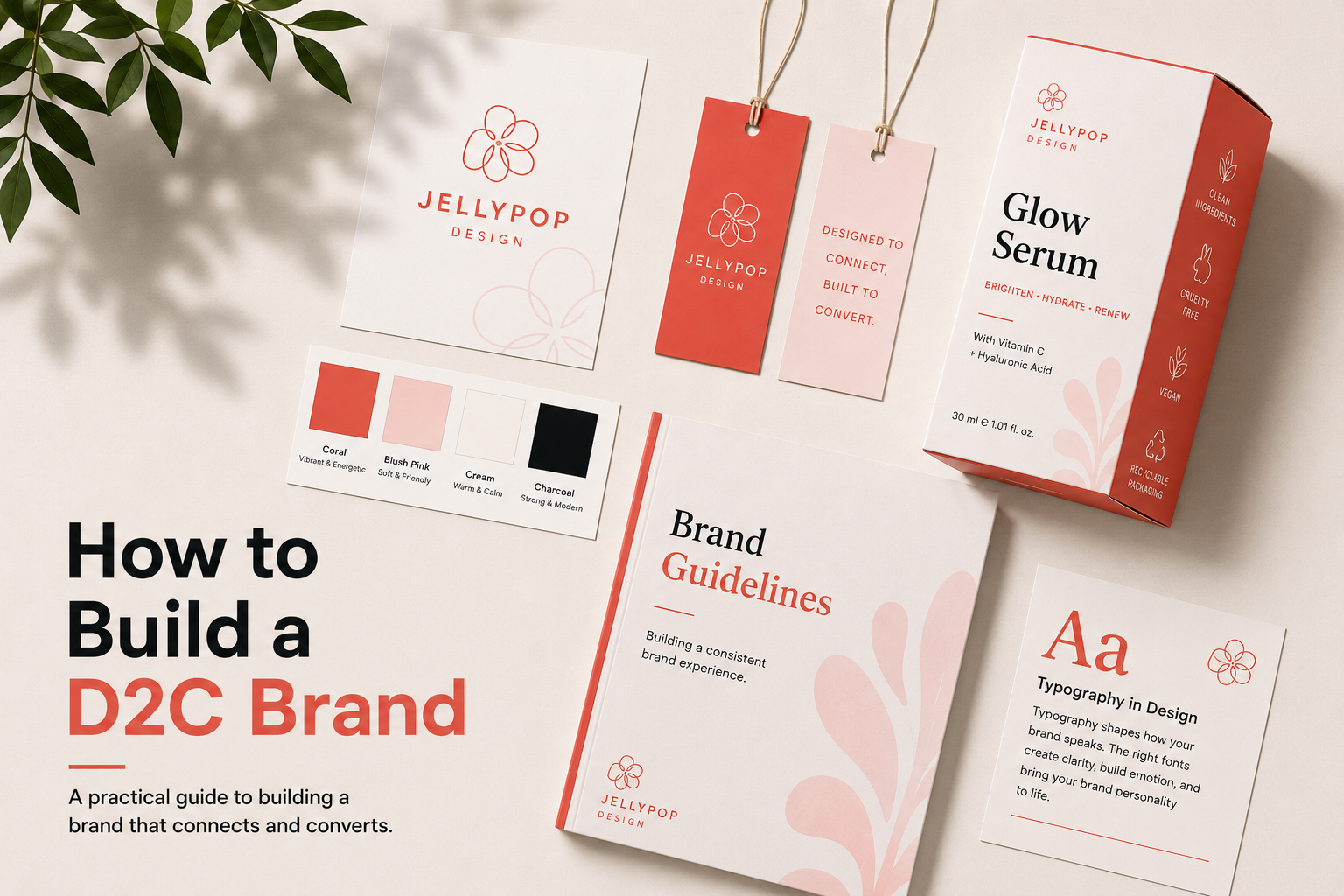
Most Indian D2C founders commission a logo and call it branding. A logo is one element of a brand identity system. The system is what builds memory.
A brand identity system includes:
- A primary logo and its approved variations (full, icon, monochrome)
- A defined colour palette with primary, secondary, and accent colours and their exact digital and print color codes
- A text layout and font arrangement with specific fonts for headlines, main paragraph text, and labels
- A visual language: the style of photography, illustration, pattern, or iconography the brand uses consistently
- A unique brand symbol or ownable visual device: a distinctive element that is not the logo but is still recognisably yours
Sugar Cosmetics owns a visual language built around bold, saturated colour and a consistent typographic treatment that makes every Instagram post, every product, and every retail dedicated store shelf space identifiable as Sugar; even when the logo is not visible. That is what a brand identity system does: it makes the brand recognisable through its parts, not just its name.
Pilgrim uses a consistent visual device: a ritual-meets-science aesthetic that draws on South Korean beauty references while adapting for Indian skin tone and beauty ritual vocabulary. The colour palette is deliberate; muted but warm, with accent colours drawn from ingredient-origin reference. Every individual item looks like the same brand because the system is defined, not improvised.
Without a system, every new product launch, every new social post, every new packaging variant is a design decision made from scratch. With a system, it is a decision made from a defined set of rules. The difference in brand consistency is significant. The difference in design cost over two years is substantial.
Step 3: Design Packaging That Sells Before Anyone Reads It
Your packaging is the first salesperson your brand has; and it works 24 hours a day, across shelf, Amazon thumbnail, Instagram reel, and Blinkit listing.
Packaging that "looks nice" is not enough. Packaging that is memorable and ready to drive sales follows specific rules:
- Front-of-pack layout arrangement. A consumer on the store shelf gives your product 3 seconds. In those 3 seconds, three things must register: what it is, what it does, and why it costs what it costs. If the brand name dominates but the product function is buried, you lose the first-time buyer. If the ingredient story is in 6-point type, you lose the considered buyer.
- Colour as brand signal. Ownable colour is one of the fastest routes to brand memory. Mamaearth's early green-and-cream palette communicated "natural" immediately. When they shifted toward a cleaner, more clinical palette in 2022-23, they were repositioning toward efficacy; a brand evolution communicated entirely through colour change, without changing the logo.
- Thumbnail test. Before any packaging goes to print, export the front face at 100x100 pixels. Can you identify the brand? Can you read the product name? Is there a dominant colour that triggers memory? Packaging that fails the thumbnail test will underperform on every online sales platform.
- Indian food safety regulatory approval as design constraint. For food, beverage, and supplement brands, legally required food safety labels (nutritional information, ingredient list, FSSAI licence number, country of origin, net quantity) occupy significant packaging surface space. Designers who do not account for these from the first draft create beautiful packaging that cannot legally ship. Build the legal requirements checklist before the design instructions document.
Step 4: Create Consistency Across Every Touchpoint
A brand is not what your packaging looks like. A brand is the sum of every experience a consumer has with your product; packaging, website, Instagram feed, unboxing, customer service message, and retail shelf display impact.
The brands that build lasting memory in India are not the ones with the best single customer interaction point. They are the ones with the most consistent set of customer interaction points.
Wellbeing Nutrition maintains visual and verbal consistency across their website, packaging, Instagram, and Amazon listings. The typography is the same. The photography style is the same. The tone of the copy is the same. A consumer who finds them through a Google search and then sees them on BigBasket shelf has the same brand experience; and that coherence builds trust faster than any single brand element can.
WOW Skin Science built aggressive consistency across digital and physical channels at a critical growth stage, which allowed them to scale paid advertising campaigns efficiently: every ad led to a campaign web page that looked exactly like the brand on shelf. Customer acquisition cost efficiency is partly a branding function. When your brand is consistent, conversion rates across channels are higher because recognition does the trust-building work before the purchase decision.
The checklist for customer interaction point consistency:
- Packaging and website use the same fonts, colour codes, and photography style
- Instagram posts are immediately identifiable as your brand without the username visible
- WhatsApp and email communication uses the same tone as your packaging copy
- Your Amazon listing images match your website's visual hierarchy
- Your retail shelf display impact matches your digital presence closely enough that a consumer recognises the brand in both settings
If any of these is inconsistent, you have a brand coherence gap. Every gap reduces the compounding effect of brand memory.
Step 5: Own a Specific Market Placement and Hold It
Memorable brands do not try to be everything to everyone. They identify a specific position in their category and own it so completely that their name becomes associated with that position.
In Indian D2C skincare, Minimalist owns ingredient transparency and science-led formulation. MCaffeine owns caffeine-based energy skincare for the Gen Z urban buyer. Pilgrim owns the Korean beauty ritual adapted for Indian skin. These are not adjacent positions; they are clearly differentiated, and each brand holds its position consistently in every communication.
The brands that lose memory are the ones that drift. A skincare brand that launches as "ingredient-forward and minimalist" and then adds a traditional herbal product collection three months later is not building a bigger brand. It is diluting the one it was building.
Category position is not just about what you say. It is about what you do not say. The Whole Truth does not claim their bars "taste amazing"; they focus entirely on what is inside. That restraint is part of the brand position. Every claim they do not make, makes the claims they do make more credible.
For Indian D2C founders: write down your market placement in one sentence. Then audit every piece of brand communication against it. If a product, a campaign, or a visual decision does not serve that placement, it is diluting it.
How to Audit Your Brand in 30 MinutesQuestions:
- Can someone describe your brand in one sentence?
- Do all SKUs look related?
- Can your product be recognized at thumbnail size?
- Does your website look like your packaging?
- Does your Instagram feel like the same company?
- Does your positioning differ from your top 5 competitors?
Score:
- 5–6 Yes = Strong
- 3–4 Yes = Needs work
- 0–2 Yes = Rebuild required
Before thinking about growth, expansion, or new product launches, it is worth checking whether the brand you have built so far is actually working. A simple brand audit can reveal gaps in positioning, consistency, and recognition that become far more expensive to fix at scale.
Step 6: Build for the Stage Your Brand Is Going To, Not the Stage It Is At
This is where most Indian D2C founders make a costly mistake. They design a brand for the stage they are at today; a small Shopify store, 3 SKUs, Instagram-first distribution; and then find that brand cannot scale when they enter large supermarket chains, raise a major institutional funding round, or expand to 20 product variants.
A brand built for a INR 50L annual sales level looks and behaves differently from a brand built for a INR 50Cr annual sales level. The core elements; the one true thing, the visual identity system, the packaging hierarchy; should be built with your three-year revenue and distribution target in mind, not your current stage.
OZiva is a useful example. Their early branding was functional and nutrition-forward, but lacked the premium visual signal needed for modern trade shelf and for positioning against international supplement brands entering India. Their rebrand invested in a visual system that worked at scale; and the result was a brand that could hold shelf space next to globally recognised supplement brands without looking outclassed.
The brief to your branding studio should include: where you want to be in 36 months, which retail channels you plan to enter, which international markets you are targeting, and what price tier you are building toward. A studio that does not ask these questions is designing for today. Jellypop designs for where you are going.
The Bottom Line for Indian D2C Founders
Building a memorable D2C brand in India is not about having a beautiful logo. It is about making clear decisions; one true thing, a coherent visual system, packaging that works at every scale, consistency across customer interaction points, a specific market placement, and a brand built for the stage you are heading toward.
The brands that are market leaders in Indian D2C in three years are making these decisions now. Not after the next funding round. Now.
If your brand was designed for a stage, you have already outgrown, or if you are launching and want to get the foundation right from the start, Jellypop builds brand identity systems for Indian D2C founders who want to be the market leader; not just a participant.
See how Jellypop builds D2C brand identities →
.png)