
.png)





How Branding Improves Customer Retention: The Real Mechanism Behind Repeat Purchases
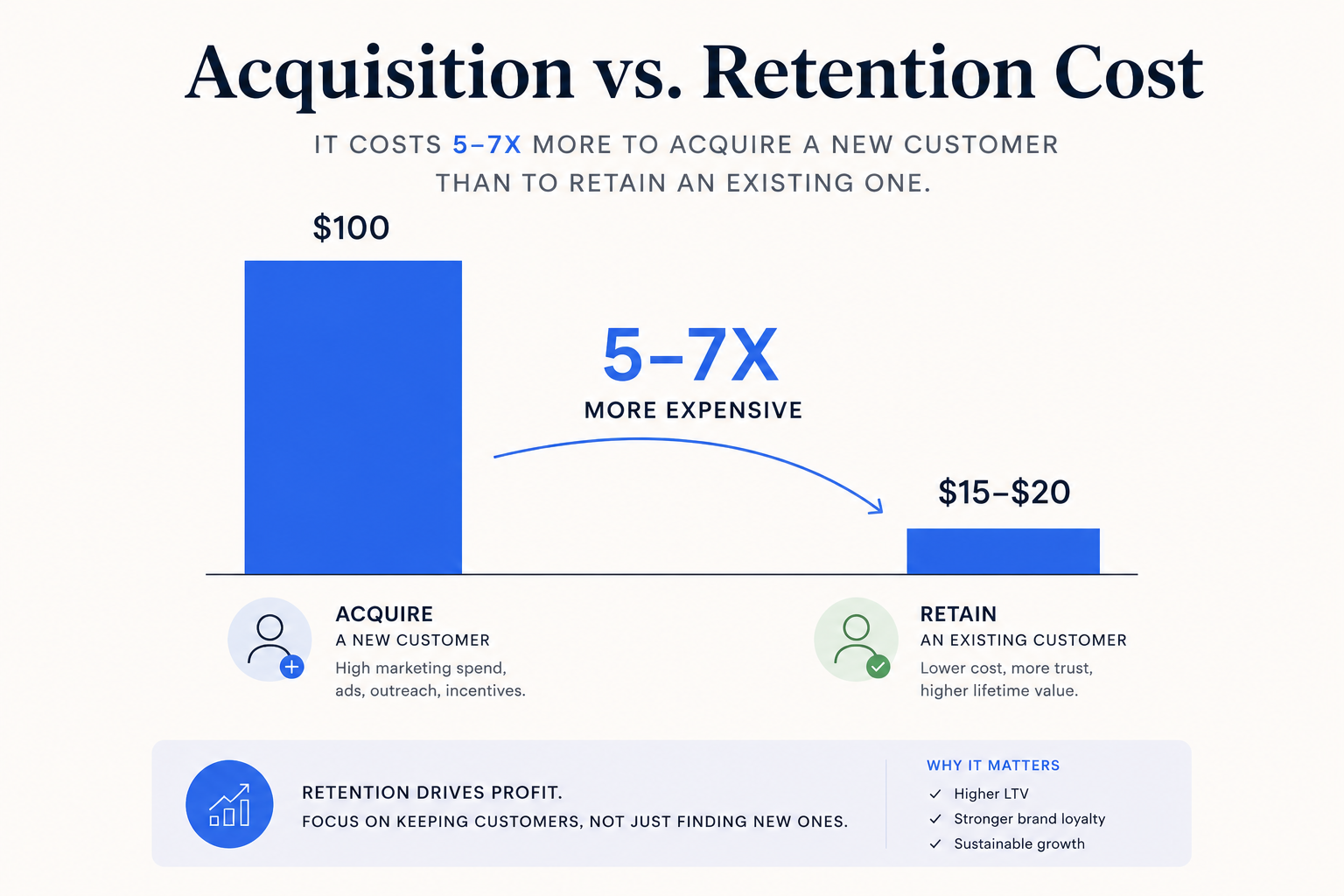
Acquiring a new customer costs five to seven times more than retaining an existing one, a finding that holds consistently across consumer categories and geographies. Yet most D2C (direct-to-consumer, meaning a brand that sells straight to shoppers rather than through a separate retailer) founders spend the majority of their marketing budget on acquisition and treat retention as an afterthought.
The customers you already have are your most efficient growth lever, and branding is what determines whether they come back.
Branding improves customer retention by reducing the decision-making effort a returning customer has to make. A customer who recognises your colours, trusts your packaging claims, and remembers how your product made them feel will choose you again faster than a customer comparing five unfamiliar options from scratch.
Retention is won in the half-second a customer recognises you on a screen or a shelf and does not have to think twice.
Most D2C founders treat retention as a CRM (customer relationship management tools, like win-back emails or loyalty apps) and discounting problem: win-back emails, referral codes, cashback. Those tools work on customers who already trust you.
Branding is what builds that trust in the first place, and what keeps it intact through every repeat purchase, whether you're selling skincare, snacks, or coffee.
What Is Customer Retention, and Why Does Branding Affect It?
Customer retention is the rate at which customers who buy once come back and buy again, without being re-acquired through paid ads or discounts. It is the metric that determines whether your unit economics improve over time or stay flat.
Brands with strong retention see CAC (customer acquisition cost, what it costs to win one new customer) payback periods shrink, LTV (lifetime value, the total revenue one customer generates over time) grow, and word-of-mouth compound, none of which happen when every customer has to be re-acquired from scratch.
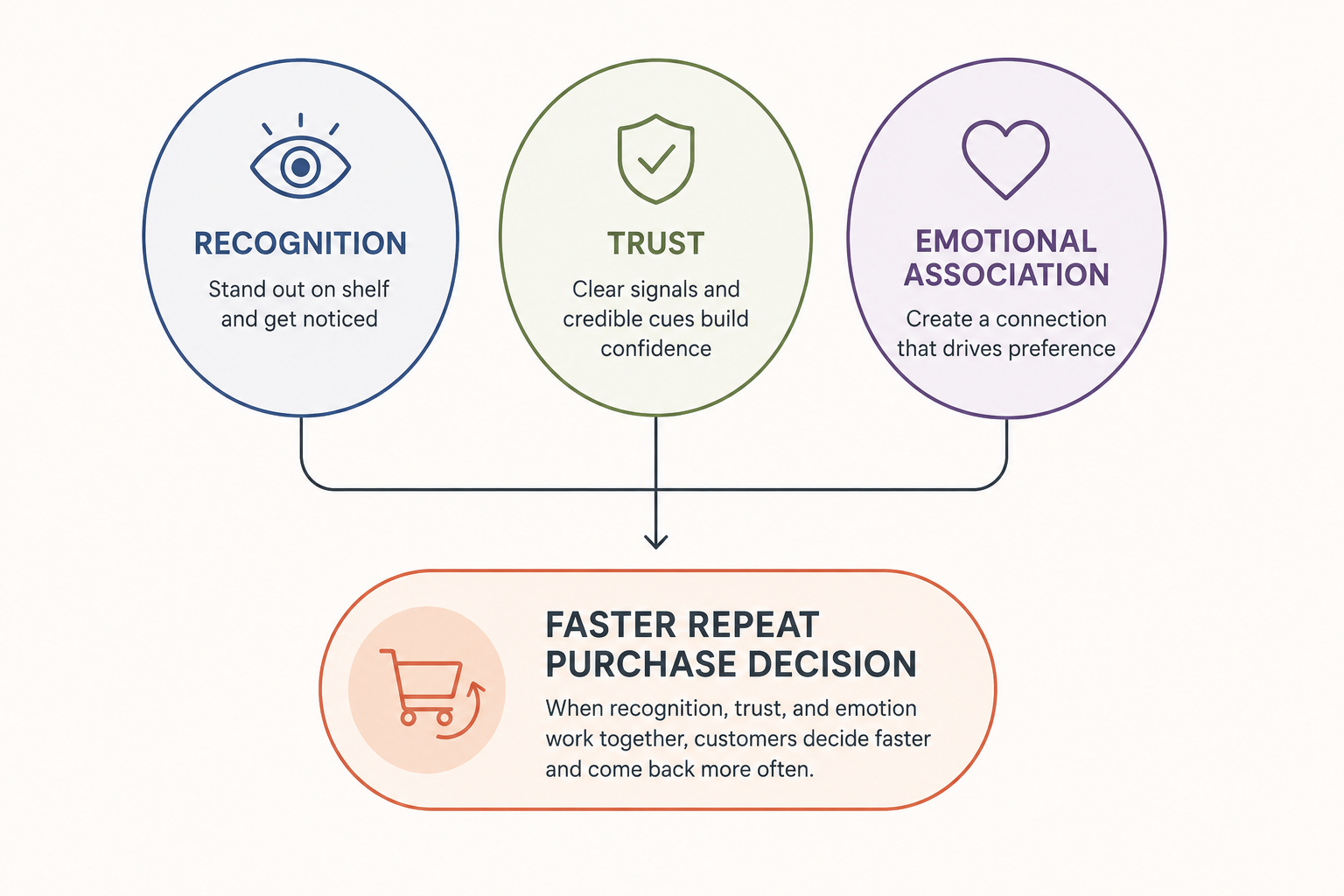
Branding affects retention because it controls three things a customer relies on to make a repeat decision quickly: recognition (do I know this brand), trust (do I believe what they tell me), and emotional association (did this make me feel a certain way last time).
A customer who reorders a skincare brand like Minimalist every month is not re-reading the ingredient list each time; they are pattern-matching against a visual and tonal system they already trust. Weak branding forces a customer to re-evaluate you on every purchase, which is expensive for them and for you.
How Branding Builds the Trust That Retention Depends On
Trust is not built by a single purchase. It is built by a brand behaving the same way across every interaction: the website, the packaging, the unboxing, the product claim, the customer support tone, and the delivery experience. Each of these touchpoints either reinforces the brand's promise or quietly contradicts it.
A customer who orders the same product twice and finds the experience inconsistent, with a different packaging finish, a shifted claim, or a support tone that does not match the brand's marketing voice, starts to wonder what else might be inconsistent, including product quality.
This is the mechanism most founders miss: retention erodes from inconsistency long before it erodes from a single bad experience.
See our guide on how branding affects customer trust or a detailed breakdown of exactly where that trust gets built or broken across the customer journey.
Five Ways Strong Branding Increases Repeat Purchases
1. Recognition reduces decision fatigue.
A returning customer scrolling Blinkit, Zepto, or Swiggy Instamart at 11pm is not doing research. They are pattern-matching, and a consistent colour, logo, and pack shape means they find you in a grid of 20 products faster than a competitor they would have to re-read.
In quick-commerce environments where the purchase decision happens in under two seconds, brand recognition is not a soft benefit, it is a conversion rate advantage.
2. Consistency signals reliability and protects pricing power.
If your product looked, felt, and performed exactly as expected last time, a customer assumes it will again. That consistency also reduces price sensitivity, since a customer who trusts your brand will pay a small premium over an unfamiliar alternative rather than risk a disappointing experience.
Inconsistent branding, such as a redesign every six months or claims that shift between batches, reads as instability even when the product itself has not changed, and it quietly erodes the pricing power the brand has built.
3. Visual identity carries emotional memory.
Customers do not remember ingredient lists; they remember how a brand made them feel. MCaffeine built its retention engine around emotional distinctiveness: neon colours, caffeine-forward naming, and a Gen Z-first tone that customers associate with energy and irreverence.
Competitors in the same category lean on clinical science and muted packaging, so MCaffeine's gap was emotional identity, not formulation, and that is what keeps a younger, repeat-purchase audience coming back.
4. Packaging reinforces the brand promise after the sale closes.
The unboxing moment is the last branding touchpoint before the product itself takes over, and it is the one most founders under-invest in. A pack that feels cheaper than the marketing promised, arrives damaged, uses visibly downgraded materials compared to the brand's positioning, or looks inconsistent with the previous order creates doubt at the exact moment loyalty should be forming.
This applies as much to a coffee subscription box or a snack hamper as it does to a skincare set: retention erodes after the purchase as reliably as it erodes before it.
5. A clear brand story builds community, not just customers.
Sugar Cosmetics retained early customers by building a visual and tonal identity specifically around Indian skin tones and everyday confidence, a positioning gap that global beauty brands in India had largely ignored.
Customers who felt genuinely seen by the brand had a reason to keep buying beyond product performance alone, and that emotional ownership of the brand converted into loyalty, referral growth, and community that no discount programme could have created.
Pick the one of these five levers your brand is weakest on right now and treat it as the first fix, since trying to improve all five at once usually means none of them move.
Branding vs Marketing: Why Retention Is Not Just a CRM Problem
Marketing creates the first purchase. Branding earns the second.
A win-back email can recover a lapsed customer for one more order, but if the underlying brand experience did not build trust the first time, that customer churns again, and the CRM spend is wasted on a problem that was never a CRM problem.
Founders who pour retention budget into CRM tools while leaving their visual identity and packaging inconsistent are treating a branding problem with a marketing solution. The cost of that mistake does not show up on launch day; it shows up six months later in churn data, in rising CAC as word-of-mouth weakens, and in flat LTV despite growing acquisition spend.
See our guide on why branding matters for startups for a breakdown of where this pattern most often appears, and what it costs.
What Actually Drives Repeat Purchases: A Quick Comparison
Founders default to discounting because it is the fastest lever to pull. It is also the most expensive to sustain and the one with the weakest long-term retention effect once the discount stops.
This is why branding-led retention tends to outperform discount-led retention over a 12-month horizon, even though it is the slower lever to see results from. It does not compete with CRM and loyalty tools, it makes them work harder, because a customer who already trusts you responds better to a win-back email than one who is still deciding whether you are credible.
Map your current retention spend against this table and check whether it's weighted toward the fast, weak-effect levers or the slower, compounding one.
What Happens When Branding Is Inconsistent
Inconsistent branding has predictable business consequences. Repeat-purchase rates fall slightly, CAC rises as word-of-mouth weakens, and pricing power erodes because the brand stops feeling distinct enough to justify a small premium over alternatives. LTV flattens even as acquisition spend grows.
The inconsistencies that cause this are usually recognisable once you know what to look for:
- Frequent visual redesigns that break the pattern recognition a returning customer has built
- Different messaging across channels, such as a premium tone on the website paired with a discount-first tone in CRM emails and an inconsistent voice on packaging
- Conflicting product claims between batches: a reformulation that is not communicated, a claim that quietly shifts, an ingredient that appears on one batch and not the next
- Visual drift as the team grows: new designers, new ad creative agencies, new packaging suppliers, each adding small departures from the original system
Analysis from Redseer Strategy Consultants points to Indian D2C and retail growth increasingly being driven by high-frequency, repeat-purchase behaviour rather than first-time acquisition alone, which means the brands that fix retention early are compounding an advantage that competitors will struggle to close later.
See our guide on branding mistakes D2C startups make: most of the patterns in that list trace back to inconsistency rather than bad initial design.
Run the four-point list above against your own brand today, since most founders find at least one without realising it had already started.
How to Build a Brand That Retains Customers
You do not need a complete rebrand to fix retention. You need consistency across six touchpoints.
1. Lock your visual system before you scale.
Colour, typography, logo usage, imagery style, and spacing rules should be documented in formal brand guidelines, not decided fresh by whoever is designing the next ad creative. Guidelines that cover what to use and what to avoid are what make consistency survivable as the team grows.
2. Make your packaging and post-purchase experience match your price tier.
A distinct, considered claim undercut by a cheap-feeling unboxing experience erodes trust faster than almost anything else. This extends beyond the pack itself: the shipping box, the tissue or filler material, the insert card if there is one, and the condition in which the product arrives all communicate whether the brand takes the post-sale experience as seriously as the pre-sale one, regardless of whether you sell beauty, food, or beverages.
3. Keep your tone consistent across every channel.
Customer support, packaging copy, social media, and CRM should sound like the same brand, not three different teams with three different briefs.
4. Do not let claims drift between batches.
A skincare brand that says "fragrance-free" on one batch and quietly adds fragrance on the next breaks the exact trust that drove the first repeat purchase. Minimalist built its retention base almost entirely on claim discipline: listing concentrations and INCI names (the standardised international naming system for cosmetic ingredients) with no embellishment, never asking a customer to take a marketing claim on faith.
That radical specificity is what a repeat buyer is actually checking for, and it is what competitors with similar formulations and more conventional packaging cannot easily replicate.
5. Audit for drift every two quarters.
Small inconsistencies creep in as teams grow and vendors change, and catching them early is cheaper than a full identity reset later. A quarterly audit against the original brand guidelines takes a few hours and prevents months of compounding drift.
6. Design the second purchase as intentionally as the first.
Most founders over-invest in the first-purchase experience and let repeat orders feel transactional. A returning customer notices when the experience gets less thoughtful, and that is a quiet way retention erodes even when acquisition stays strong.
If you are earlier in this process and still building your core identity, our guide on how to build a memorable D2C brand walks through the foundational decisions that make consistency possible.
Score your brand against the six points above before deciding whether you need a full system rebuild or just a few targeted fixes.
When to Bring In a Brand Identity Agency
Most founders do not struggle to create a logo. They struggle to maintain consistency as the team grows, new vendors come in, and the brand starts appearing across more channels and formats than the original system was designed for.
Auditing your own inconsistencies is possible once you know what to look for. Building or rebuilding the underlying system, such as colour logic, typography hierarchy, packaging guidelines, and usage rules across channels, is where most early teams either stall or end up with a patchwork identity built across several different freelancers over time.
When you are ready to build a system designed to hold up under scale, our brand identity design and packaging design services are built for D2C founders who need consistency that survives growth, not just a logo refresh.
Retention is not a loyalty programme problem. It is a consistency problem, and consistency is what branding is built to solve.